
Experts said the 20 per cent drop in the market poses a challenge for companies that have set the ball rolling on their IPO plans as valuations will now have to realign. This could entail more dilution or lowering of the issue size.

VIX is meant to indicate investors' perception of the annual market volatility over the next 30 calendar days. The higher the value, the higher is the expected volatility and vice versa. VIX touched its historical peak of 85.13 on November 17, 2008, in the aftermath of the collapse of Lehman Brothers. In the past five years, it has stayed below 30.

Market players said NBFCs and HNIs are recalibrating their plans based on the changing dynamics.
Both indices are down nearly 9 per cent from their all-time highs in mid-January. A sharp reversal seems difficult this time as the peak impact of the virus is yet to play out.
The answer to that depends on whether the globe is able to contain the virus spread, says Samie Modak.

Naved Masood, former secretary in the Ministry of Corporate Affairs and Sebi board member; TV Mohandas Pai, chairman of Manipal Global Education and Dinesh Kanabar, CEO, Dhruva Advisors have ceded their position on the NSE board following end of their tenure.

At issue size of Rs 10,355 cr, the offering will be Asia's biggest this year and fifth-largest domestically.

Amendment to the Act, sovereign guarantees, investment portfolio, realty holdings, and governance issues to shape valuation.
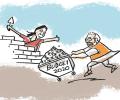
The Budget has relaxed a few safe harbour rules that aim to make it easier for fund managers overseeing offshore India-focused funds to relocate to the country.

India is often viewed as an aggressive tax jurisdiction by domestic and overseas taxpayers, and making the charter as part of the Act may help restore confidence among taxpayers.

In the past 10 trading sessions, shares of the state-owned company have shot up more than 50 per cent.
The regulator has asked portfolio managers not to leverage the portfolio of clients for investment in derivatives and not indulge in speculative transactions that are not accompanied by actual delivery, except for derivatives trades. This is done with the intention of reducing volatility in the market and curbing undue risks.

Last October's circular meant that downstream investment by such funds by way of subscription or acquisition of shares would have been considered "indirect foreign investment" if their investment manager or sponsor is owned or controlled by a non-resident. The finance ministry has now said that mutual funds that invest more than 50 per cent in equity shall be omitted from the Securities and Exchange Board of India (Mutual Funds) Regulations, 1996.

On an overall basis, Nomura believes the economic conditions are suited for equity markets. The brokerage is predicting the market performance will be better in the first half of 2020 and "somewhat weaker" in the second half.

'Trading is about psychology; 75% of it is about keeping your emotions in check.'

The asset manager is yet to resolve the impasse surrounding the payment of pension to its erstwhile employees who had opted for voluntary retirement in 2003.

Hopes of revival and earnings growth in 2020, surprise tax cuts, and robust foreign flows - thanks to easy global monetary policies - are a few reasons why the markets have managed to digest the low GDP footprint. Select bluechips such as Reliance Industries, Bajaj Finance, Asian Paints, and ICICI Bank have gained sharply this year. On the other hand, YES Bank, Zee Entertainment, and Indiabulls Housing have seen a sharp fall.

In the aftermath of the Karvy incident, lending against third-party collateral facility raises questions over regulations concerning banks and brokers which are at loggerheads. While Sebi and NSDL have ordered the transfer of securities, which were kept as collateral, lenders followed the old business model of sanctioning loan against shares and allegedly overlooked certain parameters. Legal experts feel that this could lead to a collapse of the loan-against-shares market as it raises questions over the sanctity of the pledged securities.

Investment experts said the key to generating superior returns was "asset allocation" and taking money out of the table from themes that have performed well and into themes that are available at a discount.

Sebi has now said any default of payments of interest or principal on loans taken from financial institutions, including banks, will have to be disclosed if it continues beyond 30 days.
 © 2026 Rediff.com - Investor Information - Advertise with us - Disclaimer - Privacy Policy - Sitemap - Feedback - About us - Terms of use - Grievances